
500 drone swarm spectrum warfare
Explore why large swarm drone systems become RF and synchronization challenges rather than pure AI problems. Learn about distributed autonomy, mesh networking, EW resilience, and next-generation autonomous UAV architectures.
DEFENCE
Aerion Aerospace Research Team
5/30/20264 min read
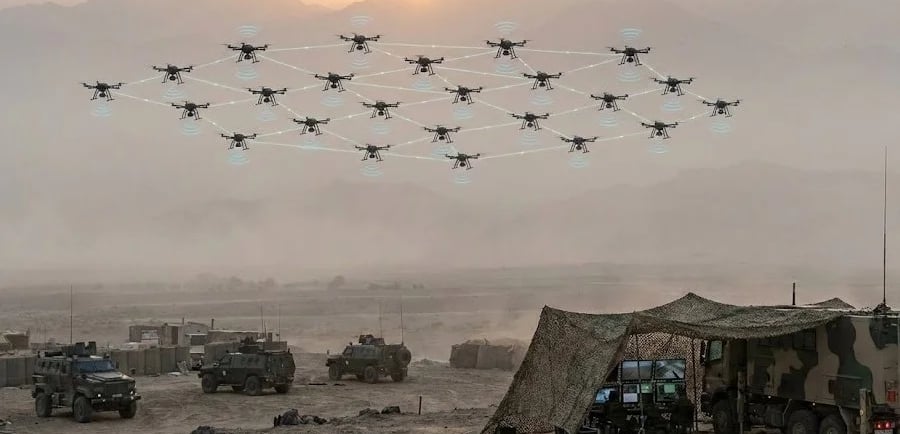
Why a 500-Drone Swarm Becomes a Spectrum Warfare Problem
Most discussions around swarm drones focus heavily on AI.
Object detection. Autonomous navigation. Collaborative targeting. Computer vision.
But in real-world swarm systems, AI is rarely the primary engineering bottleneck.
Synchronization is.
The moment a swarm scales from a small autonomous formation into a dense multi-agent aerial network, the engineering problem changes fundamentally.
A 5-drone swarm is manageable.
A 50-drone swarm becomes an RF architecture challenge.
A 500-drone swarm becomes a spectrum warfare problem.
This is because modern swarm drones are not simply autonomous UAVs operating together. They are distributed airborne robotic systems continuously exchanging telemetry, positioning data, formation-state information, obstacle awareness, navigation updates, and mission-state synchronization.
Every drone becomes:
an autonomous aerial platform
and a real-time network participant
That distinction is critical.
Because collective swarm behavior depends less on individual intelligence and more on synchronization coherence across the network.
Swarm Drones Are Distributed Systems
At scale, swarm drones behave more like distributed computing clusters than traditional UAV fleets.
The engineering parallels are remarkably similar:
Distributed ComputingSwarm Drone SystemsNetwork latencyRF communication delayClock driftFlight synchronization errorNode failureUAV loss or disruptionDistributed state updatesFormation synchronizationConsensus protocolsCooperative autonomy logicFault toleranceMission survivability
The challenge becomes maintaining coherent global behavior while every airborne node operates with incomplete local information.
This is precisely where most simplified swarm-drone discussions diverge from operational reality.
Because communication physics imposes hard constraints.
And physics always wins.
The Hidden Constraint: Timing Drift
One of the least discussed swarm engineering problems is timing drift.
Every UAV in a swarm operates using onboard clocks and synchronization routines.
Even high-quality systems experience drift due to:
thermal variation
vibration
processor load
power fluctuations
environmental disturbances
Now consider a swarm flying at:
18 m/s velocity
with a 40 ms synchronization offset
The positional deviation becomes:
d = v \times t = 18 \times 0.04 = 0.72\text{ m}
A 72 cm formation deviation introduced purely from timing inconsistency.
Now multiply that across:
packet retransmissions
GNSS uncertainty
mesh-network latency
obstacle avoidance corrections
aerodynamic disturbances
Formation coherence rapidly degrades.
Not because the drones lack autonomy.
Because their perception of time becomes inconsistent.
RF Congestion Scales Aggressively
Swarm communication complexity does not scale linearly.
It scales aggressively with node density.
Consider:
50 drones
250-byte telemetry packets
20 Hz update frequency
The telemetry traffic becomes:
50 \times 250 \times 20 = 250000\text{ bytes/sec}
Approximately 250 KB/s of continuous coordination traffic.
And this excludes:
video transmission
routing overhead
encryption
retransmissions
mesh synchronization traffic
sensor fusion data
In real RF environments, usable bandwidth collapses far faster than expected.
Especially under:
urban interference
contested electromagnetic environments
GPS degradation
electronic warfare conditions
This is why large swarm systems increasingly become RF engineering problems rather than purely autonomy problems.
Mesh Networking Is Not a Perfect Solution
Airborne mesh networking is often presented as the universal answer to swarm scalability.
In practice, it introduces additional latency layers.
Every relay hop adds:
transmission delay
routing computation
synchronization uncertainty
retransmission risk
Assume:
each relay hop introduces 5 ms delay
swarm coordination requires sub-20 ms response timing
After only four relay hops:
4 \times 5 = 20\text{ ms}
the entire coordination latency budget is consumed.
This becomes critical during:
cooperative obstacle avoidance
formation correction
collaborative target tracking
synchronized maneuver execution
The larger the swarm becomes, the harder low-latency coordination becomes.
Centralized Swarms vs Distributed Autonomy
Early swarm architectures relied heavily on centralized control systems.
A single node coordinated the formation.
While this simplifies orchestration, it creates major operational vulnerabilities:
communication bottlenecks
single-point failure
poor scalability
large RF signatures
vulnerability to jamming
This is why modern defence programs increasingly focus on decentralized collaborative autonomy.
In distributed swarm systems:
each UAV makes localized decisions
coordination emerges collaboratively
communication becomes contextual
autonomy shifts toward the edge
This architecture resembles biological systems more than traditional robotics.
Bird flocks.
Fish schools.
Ant colonies.
No single node controls the entire network.
Instead, collective behavior emerges through localized interaction rules.
GPS-Denied Swarm Operations
Operational environments rarely guarantee GPS availability.
Modern battlefields increasingly involve:
GPS spoofing
RF jamming
communication denial
degraded navigation environments
This forces swarm systems toward alternative navigation methods including:
visual SLAM
inertial navigation
visual odometry
inter-agent localization
collaborative mapping
sensor fusion
Now the synchronization challenge becomes even more difficult.
Because drones must maintain formation coherence while each node operates with partial environmental awareness.
Global Defence Programs Are Already Addressing This
The global defence ecosystem has already recognized these limitations.
DARPA OFFSET explored scalable collaborative autonomy involving hundreds of coordinated autonomous systems operating in dense urban environments.
DARPA Gremlins investigated recoverable autonomous aerial systems operating collaboratively with manned aircraft under distributed mission architectures.
Anduril Industries has increasingly focused on distributed sensing, collaborative autonomy, and edge-coordinated autonomous systems.
Meanwhile:
MIT continues advancing distributed robotics research
ETH Zürich demonstrated highly coordinated autonomous multi-UAV flight in GPS-denied conditions
NASA has explored distributed robotic coordination for planetary missions
Chinese swarm demonstrations have also publicly shown coordinated operation involving hundreds to thousands of UAVs simultaneously.
But synchronized demonstrations alone do not guarantee operational survivability.
The real engineering challenge begins under:
RF degradation
packet collision
electronic warfare pressure
communication loss
intermittent synchronization
node failures
That is where real swarm architecture matters.
The Future of Swarm Systems
Future swarm systems will likely depend less on continuous communication and more on:
event-driven coordination
edge AI
resilient mesh networking
adaptive RF management
distributed navigation
autonomous fallback logic
collaborative edge computing
Because in contested environments, the most survivable swarm may not be the most connected swarm.
But the swarm least dependent on constant communication.
That is a major architectural shift now emerging across modern autonomous defence systems.
As India moves toward Atmanirbhar Bharat in advanced defence technology, indigenous development of distributed autonomy, collaborative robotics, embedded systems, RF-resilient UAV architectures, and autonomous swarm coordination will become increasingly important.
The future of autonomous aerial systems will depend less on individual drone intelligence and more on how efficiently autonomous systems synchronize, coordinate, and survive collectively under constrained real-world environments.
That is the real engineering frontier.
#SwarmDrones #AutonomousUAV #DistributedRobotics #DefenceTechnology #ElectronicWarfare #CollaborativeAutonomy #EdgeAI #MeshNetworking #DroneSwarm #AerospaceEngineering #AtmanirbharBharat #MakeInIndia #AutonomousSystems #AerionAerospace
Aerion Aerospace Pvt Ltd
Contacts
+91 9172326773
info@aerionaerospace.in
Subscribe to our newsletter